Mars The story
Mars, starting with water: the story in my own posts
I post my Mars thinking on X a piece at a time. Here are 14 of those posts stitched into one read, in the order I’d tell it. Every passage is my own words, and every one links back to the original.
Concept work, not tested. This is independent hobby work by a builder, not a plan anyone has run. Ice on Mars is probable, not proven. Labels on each part work the same as on the rest of this site: Cited comes from a published source, Calculated is my arithmetic, Estimate is my best guess, Concept is an idea not built or tested, Unknown means nobody can say yet, and My opinion is a builder’s judgment.
How this page was put together
- The quoted passages are posts from my X account, @TacomaBryan, joined in story order. The short connecting lines between them, and the lead-in in Part 5, are the only new text.
- I removed @-tags, hashtags, emoji and picture links to make them read cleanly on a page. Anything else I cut is marked […], and each source line says what was trimmed.
- Anything in [square brackets] is my edit, not the original wording. Company and vehicle names are replaced with [bracketed generic words]. […] marks a cut.
- I didn’t add claims. If a post said “estimate,” it still says estimate. Numbers keep the labels they had when I posted them.
- Posts are quoted as they were on X. Corrections welcome there, and I’ll fix what I got wrong.
Part 1 of 6
The picture at the end
I started with the end in mind: a first city, and a small crater where it begins.
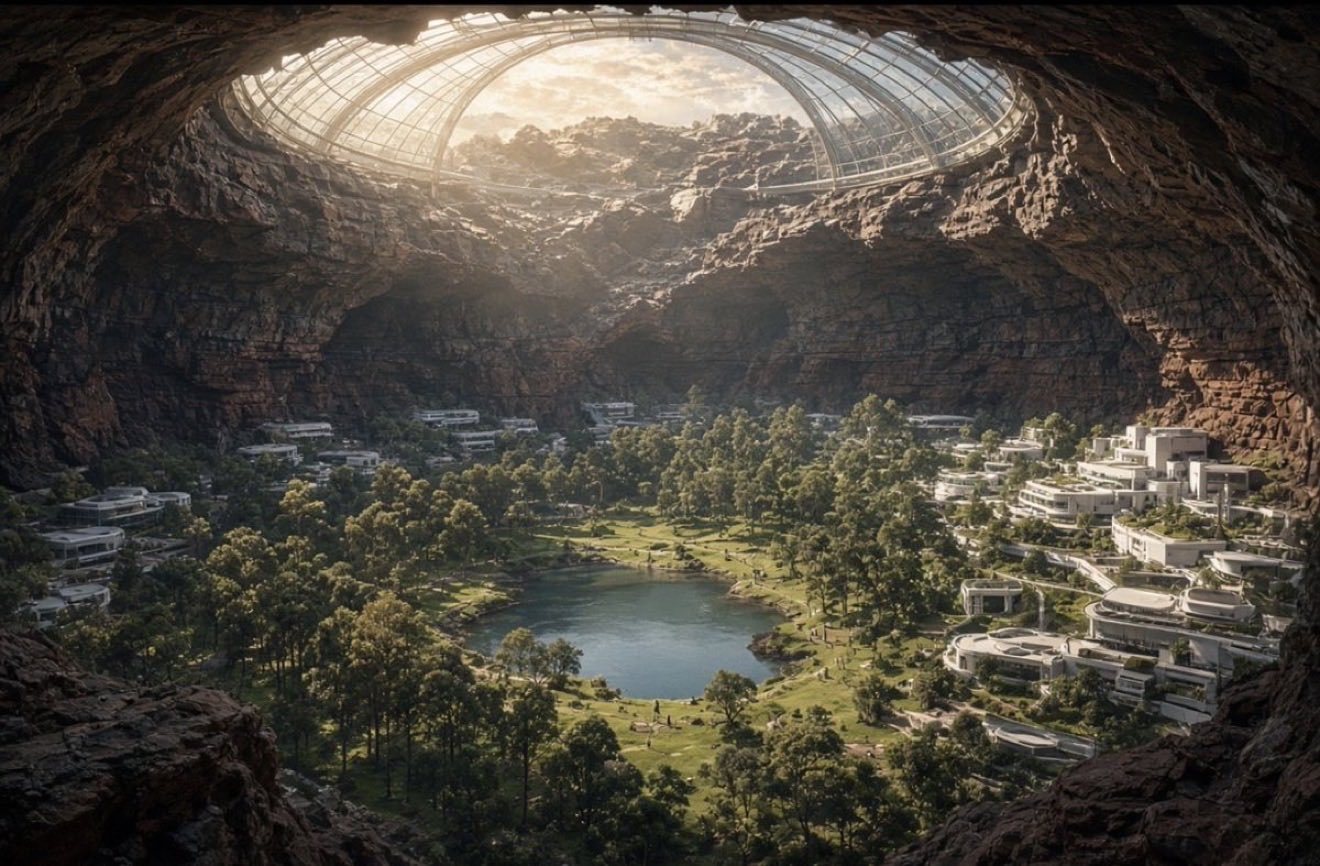
The first city on Mars should start as a water plant in a small crater.
I started with the end in mind. The image is the vision, an end goal for humanity, made as AI concept art: a sealed dome over a giant crater with people and trees living under it. Nothing like it is built. But it starts small, in a smaller crater, to prove out the machine that supports life.
[Here’s the kind of place I’d look at first:] a small crater […] near Erebus Montes in Arcadia Planitia. In NASA CTX imagery it’s about 127 m across [Estimate: my own read of NASA CTX imagery, not independently checked; I have not linked the image]. Its depth isn’t measured; we estimate around 25 m. A ~100 m dome over a crater that size is the concept.
Why there: radar on NASA’s Mars Reconnaissance Orbiter points to widespread buried ice across Arcadia Planitia (Bramson et al. 2015).
Step one isn’t the dome. Robots land first, dig ice, melt it into clean water, and keep the power on through a months-long storm. Melting ice on Mars hasn’t been done yet, so we test it on Earth first.
Then tunnels. Our concept is [a tunneling machine] […] (proposed; no machine this size has flown), with capsules a bit smaller so they can move through the tunnel.
Crew comes when the water, power and air hold.
What would you check first about [a small crater like this one in Erebus Montes]?
Part 2 of 6
Is there water to start with?
Probable, from orbit. Not proven, and not yet recoverable water.
That’s the picture at the end. Everything in it depends on a first question: is there water to start with?
Radar points to buried ice at Erebus Montes, Arcadia Planitia: mid-latitude (~40°N), low elevation. […] Fresh craters in the region have exposed bright ice.
A candidate, not a selection. Ice in the ground isn’t proven recoverable water.
How much water is hiding under Erebus?
NASA radar (Bramson et al. 2015) found [ice reaching down to roughly 130–165 ft (depth to the bottom of the layer; the layer itself is a bit thinner)], up to ~75% ice [by volume]. Regionally: ~3–16 quadrillion gallons.
[My rough math for a 6-mile radius around one spot in the region: ~2.5 trillion gallons (estimate).]
Estimates until we drill.
Part 3 of 6
Water first
In my thinking, water comes before fuel, and power is the real limit.
If the water’s probably there, the thinking has to start with it.
1/ Water first: in [my thinking], water comes before propellant. Methane is CO2 plus hydrogen from split water, and that same water feeds the air and greenhouses. Later, Mars could become a refueling station, with fuel as its #1 export. […]
2/ The ice budget: Arcadia buried ice is about 13,000-61,000 cubic km (Bramson et al. 2015), or about 5-24 billion Olympic pools. Nearby ice ~4 million pools (ESTIMATE). Split into thirds (reserve, industry, people) it still outlasts a long build-out. Estimates until drilled.
3/ Honest limits: ice isn’t the bottleneck; power is. Lava tubes near Erebus are unconfirmed, so bored tunnels have to scale. Lithium is scarce, so iron-air batteries. Engines are temporary during the build-out. Corrections welcome.
Part 4 of 6
Getting the water out
A sharp question from a friend, and a way to answer it on Earth before anyone goes.
Which leaves the practical question: how do you get it out of the ground?
A dam engineering friend asked a sharp question: why melt Mars ice in the ground when you could cut it into blocks, like old lake ice harvesters did, and melt it in one warm plant?
Two catches: bare ice on Mars turns to vapor fast, and much of it may be ice-soaked gravel, not clean ice.
So which is it under Arcadia, clean ice or frozen gravel?
Nobody has mined and melted Mars ice for water yet, so we test on Earth first. Cut buried ice into blocks and melt it later, or melt it where it sits? Same scorecard for both: water per energy, ice lost to vapor, dirt, what breaks. Concept only. Nothing has been run.
Part 5 of 6
Power, and the engine
Storing power as hydrogen and burning it in sealed argon. It stores energy; it doesn’t make it.
Water needs power to melt and split it. That’s where the engine comes in.
Builder’s question […]: could a sealed hydrogen-argon engine store power on Mars and give the water back?
Short answer: it stores energy, it doesn’t make it. About 30% round trip, every number labeled.
Corrections welcome.
My first post, before I’d done the math. Two things in it I no longer say: that the engine makes power from ice, and that 60–70% has been shown in a closed loop.
Early uncrewed [ships] can land a closed-loop hydrogen–argon engine that turns local Martian ice and atmospheric argon (~1.6–2%) into high-efficiency (60–70%) power plus pure water. Combustion is 2H₂ + O₂ → 2H₂O; argon is the recycled monatomic working fluid. Published work shows these efficiencies while recovering the water habitats need. Mars already supplies both resources.
Quick clarification on the Wang et al. number: it’s [69.8% net indicated (my post said 70.2%; corrected to match the paper’s abstract)] (Int. J. Hydrogen Energy, 2026). Closed-loop results with a condenser are lower once pumping losses and impurity accumulation are included (see SAE 2025-24-0001 at ~56–59%). [The lab number is an in-cylinder result from an Earth test engine; closed-loop packaging is the open item.]
Part 6 of 6
Where it ends up
A gas station first. Then robots, and the boulder starts to roll.
So where does that leave the whole idea?
Mars is a gas station first: water and fuel, with very little livable real estate. Getting there first doesn’t get you much on its own. But if robots start building and that boulder begins to roll, habitable space grows. That’s the real work. Concept only.
[…] The rocket gets you there, but water is what lets you stay: robots first, water first, life support before anything else. Fuel can wait until the ships prove they can refill.
And the landing pad? Bake the dust into stone and keep it dry. On Mars, water is too precious to spray on concrete.
Before crew, robots must prove:
Ice dug and melted into clean water.
Power that holds with one source down.
Air made and a 30-day reserve filled.
A failed part swapped with no one there.
Gear built to work now and be reused later.
Notes and sources
A note on the engine numbers. The “60–70%” and “56–59%” figures in Part 5 are efficiency results from Earth lab engines (the ~64–70% range) and from an engine simulation (the ~56–59% range), all measured or computed inside the cylinder (indicated efficiency). They are not electrical output from a Mars machine. On the engine page I assume a lower 50% fuel-to-electricity figure and calculate a round trip of about 30%. Estimate
About the bracketed edits
Anything in [square brackets] on this page is my edit, not the wording of the original post: a correction, a source label, or a generic word in place of a company or vehicle name. […] marks a cut. Three corrections to my own posts are made here: ice “reaching down to” a depth, where my post said “thick” (Part 2); the Wang et al. figure, 69.8% where my post said 70.2% (Part 5); and the site wording in Part 1. The originals on X are unchanged.
Sources named in these posts
- Bramson et al. (2015), “Widespread excess ice in Arcadia Planitia, Mars,” Geophysical Research Letters 42, 6566–6574. arXiv copy · DOI
- Wang et al., “Theoretical and experimental researches on the pathway to achieve a net indicated thermal efficiency of 70 % by an argon power cycle hydrogen-fueled engine,” Int. J. Hydrogen Energy 198 (2026), 152765. DOI · SSRN preprint
- The Mars ice evidence in more detail, with its own sources: Ice: probable, not proven.
- “SAE 2025-24-0001” is named as written in my original post; I haven’t linked it.
The posts used, in order
- Nov 11, 2026 · x.com/TacomaBryan/status/2120574432934850930
- Nov 8, 2026 · x.com/TacomaBryan/status/2119651842418528415
- Nov 8, 2026 · x.com/TacomaBryan/status/2119652463280271784
- Nov 6, 2026 · x.com/TacomaBryan/status/2118736463080669187
- Nov 6, 2026 · x.com/TacomaBryan/status/2118737687829946526
- Nov 6, 2026 · x.com/TacomaBryan/status/2118738080131850463
- Nov 10, 2026 · x.com/TacomaBryan/status/2120314176778453230
- Nov 12, 2026 · x.com/TacomaBryan/status/2121034179030958325
- Nov 19, 2026 · x.com/TacomaBryan/status/2123526245212402163
- Oct 31, 2026 · x.com/TacomaBryan/status/2116661273748517214
- Nov 2, 2026 · x.com/TacomaBryan/status/2117459527222304987
- Nov 15, 2026 · x.com/TacomaBryan/status/2121982668581777452
- Nov 13, 2026 · x.com/TacomaBryan/status/2121380705372700985
- Nov 9, 2026 · x.com/TacomaBryan/status/2119922232596275404
Posts and dates as shown on X on Nov 19, 2026 (Pacific time). Public engagement on these posts is small, and I’d rather show you the thinking than the numbers.