Mars Engine concept
Concept work, not tested
A Mars power module that gives the water back
An early concept for storing power on Mars as hydrogen and oxygen, burned in a sealed argon engine that returns the water. Every number is labeled as cited, calculated or estimated.
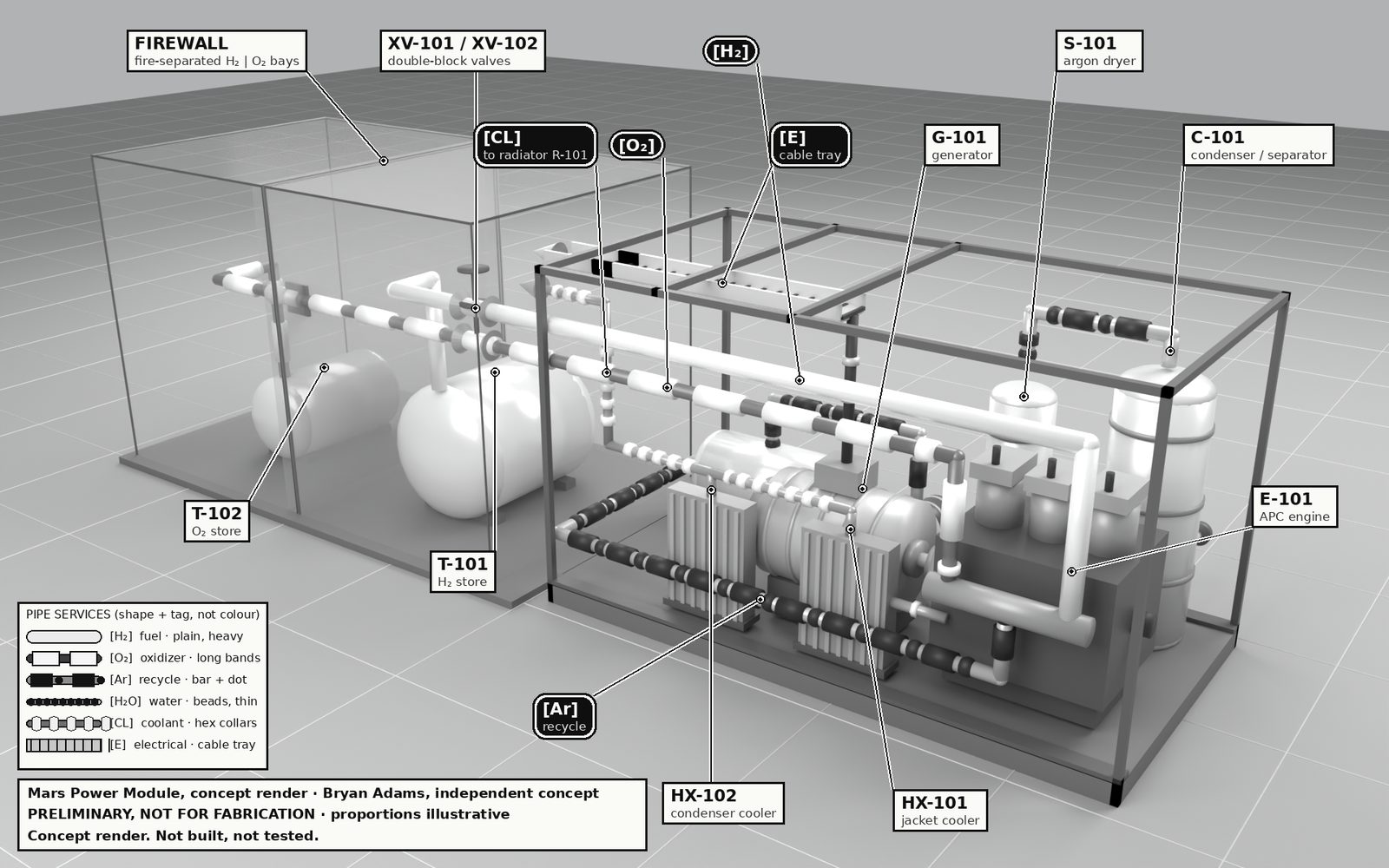
Concept work, not tested. This is an independent builder’s sketch. Nothing has been built or run, and no outside expert has reviewed or endorsed it; the only review so far was by a simulated AI committee. It is not a certified drawing and it is not for fabrication. Ice on Mars is probable, not proven. Corrections welcome on X: @TacomaBryan.
How it works
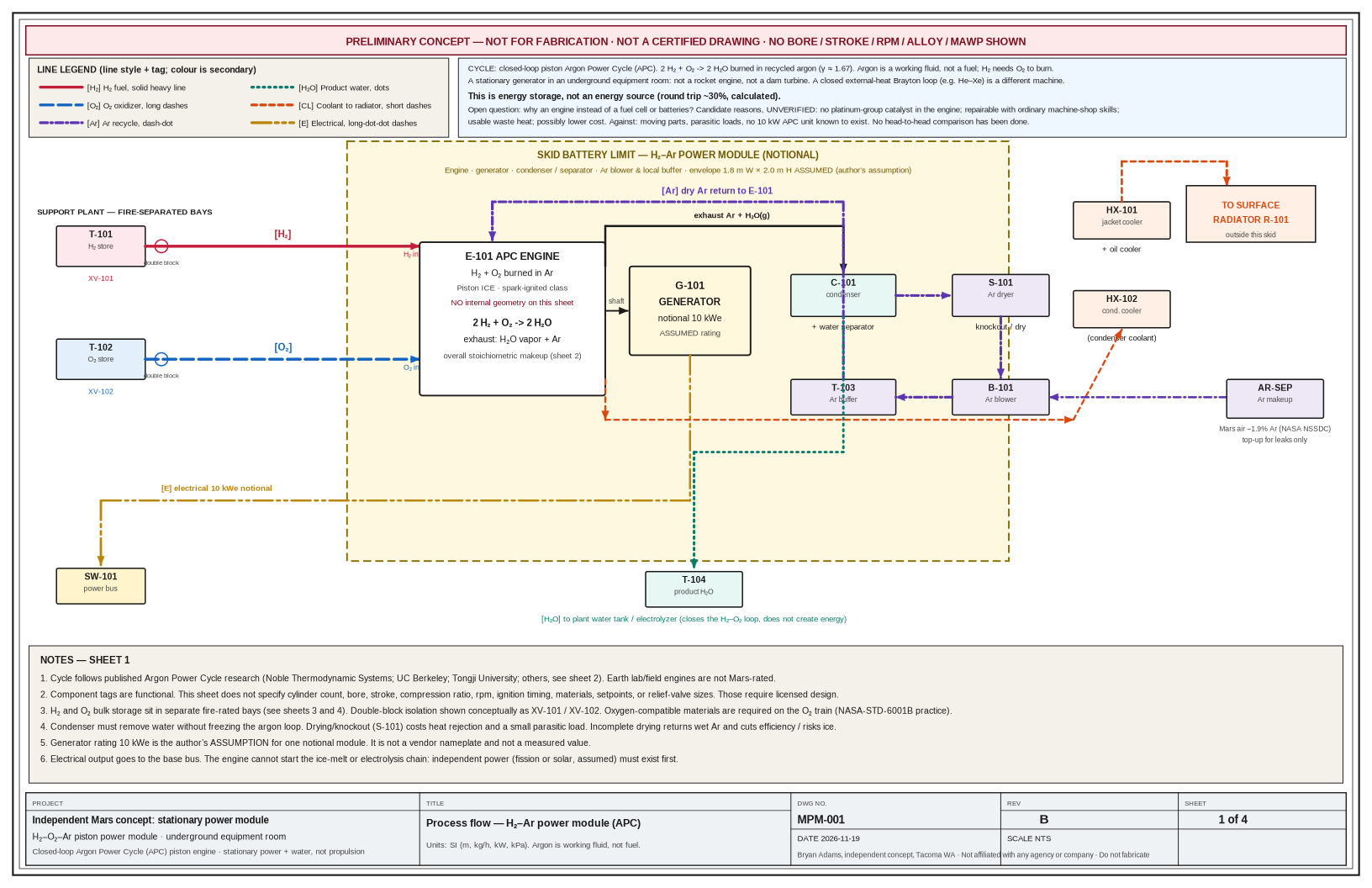
- Store. When there’s spare power (solar or fission), an electrolyzer splits water into hydrogen and oxygen, kept in separate tanks.
- Run. When power is needed, the engine burns hydrogen and oxygen in argon instead of air. Argon is a monatomic gas, which lets a piston engine run more efficiently than it would on air. Cited [2] [3]
- Recover. The exhaust is just steam and argon. The steam is condensed back to water and the argon is dried and reused, so the loop stays closed.
- Top up. Small argon leaks can be replaced from the Mars air, which is about 1.9% argon. Cited [1]
What it is, and what it isn’t
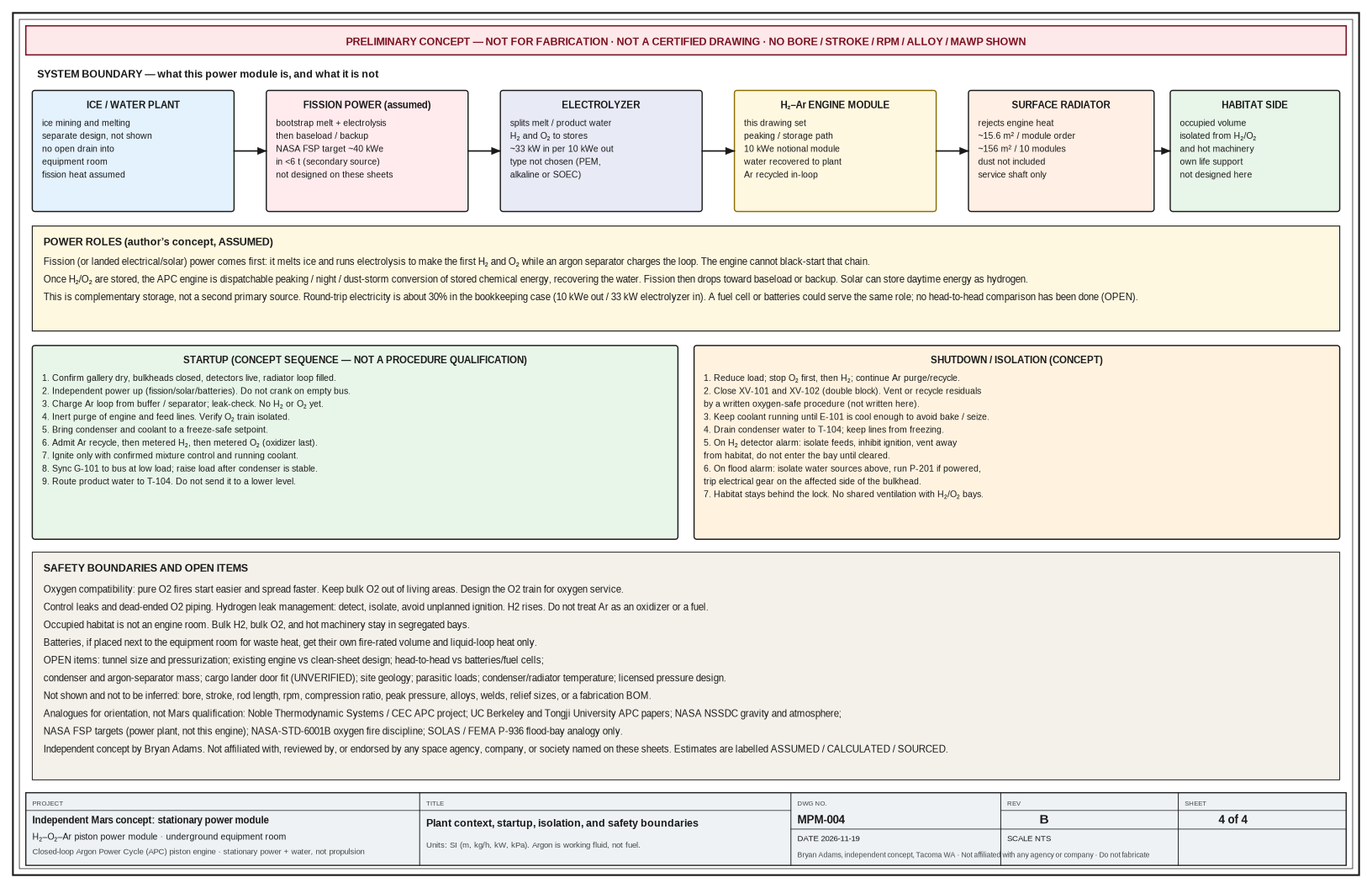
- It’s energy storage, not an energy source. The calculated round trip is about 30%: water is split and then remade, not created. Calculated
- It’s a stationary generator in an underground equipment room. It is not a rocket engine.
- Why an engine instead of a fuel cell or batteries? Possible reasons, all Unknown: no platinum catalyst, repairable with ordinary machine-shop skills, and usable waste heat. Reasons against: moving parts and lower efficiency. No head-to-head comparison has been done yet.
- It can’t start the chain by itself. Independent power (fission or solar, assumed) has to melt the ice and run the electrolyzer first. See Gravity over pumps for where the energy bill actually is.
Key numbers, one notional module
Every row says where it came from. Estimate here means I picked the number to have something to calculate with.
Label words match the legend on the Mars page. The drawing sheets use older words for the same labels: ASSUMED = Estimate, SOURCED = Cited, CALCULATED = Calculated, UNVERIFIED = Unknown.
| Item | Value | Status |
|---|---|---|
| Electrical output | 10 kW | Estimate |
| Engine efficiency, fuel to electricity | 50% | Estimate |
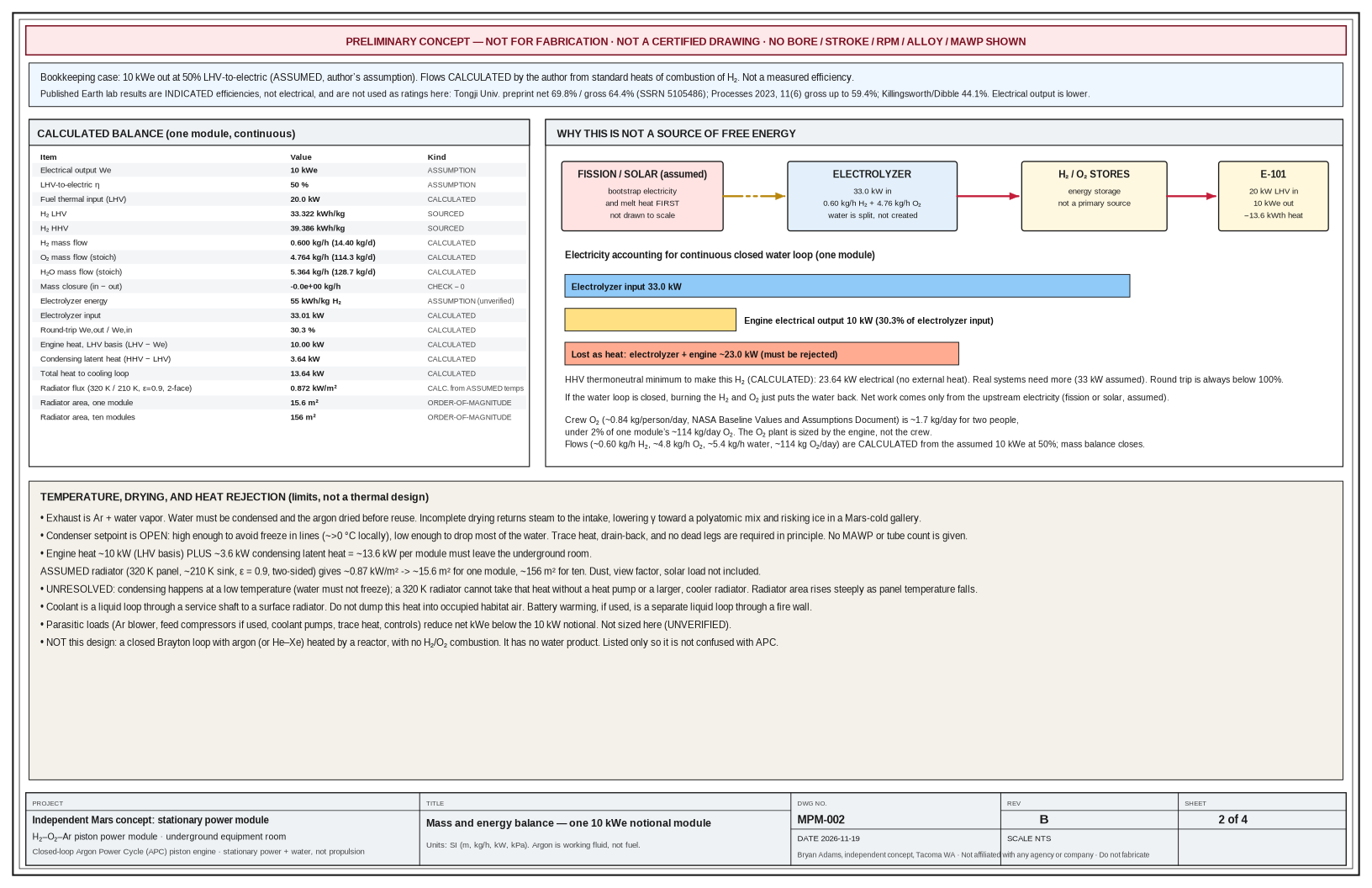
| Fuel use at full load | 0.60 kg/h hydrogen + 4.76 kg/h oxygen makes 5.36 kg/h water | Calculated |
| Round trip, electricity in to electricity out | about 30% | Calculated assumes an electrolyzer using 55 kWh per kg of hydrogen Estimate |
| Heat to reject | about 13.6 kW; radiator roughly 16 m² (order of magnitude, one case) | Calculated · Order of magnitude · condenser temperature unresolved. From assumed temperatures. |
| Argon in Mars air | about 1.9% | Cited [1] |
Why 50% here, when lab engines report more. Published Earth lab results for argon-cycle hydrogen engines reach up to roughly 70% in the papers below, but those are indicated efficiencies measured inside the cylinder, not electrical output, and none is Mars-rated. Cited [2] [3] I use a lower 50% fuel-to-electricity figure and label it an Estimate. Closed-loop packaging (condenser, pumping losses, impurities) is the open item.
Open questions
- Adapt an existing engine, or design one from scratch? No 10 kW argon-cycle engine is known to exist.
- The condenser has to run cold while the radiator runs warm. That takes a heat pump or a bigger radiator, and it’s unresolved.
- Electrolyzer type and energy use, parasitic loads, and the comparison against fuel cells and batteries.
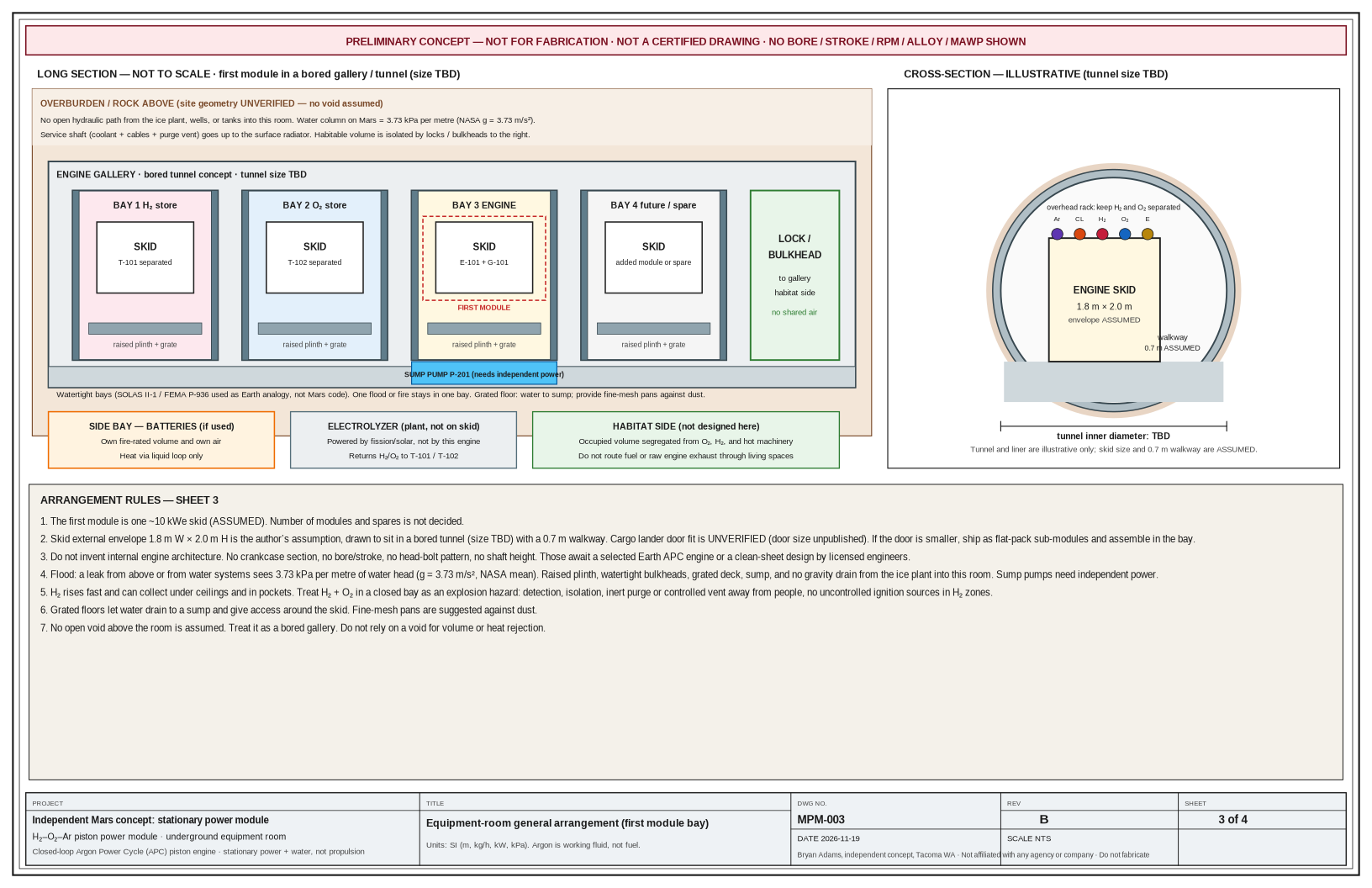
- Tunnel size, whether the skid fits through a cargo lander door (door size is unpublished), and the site geology.
The four-sheet drawing set
Tabloid-size concept drawings, MPM-001 to MPM-004. Marked preliminary and not for fabrication on every sheet. They’re wide, so tap a sheet to open it full size, or download the handout as a PDF.
Where this fits, and where it came from
On the water chain, this sits at link 2, the power. It’s one possible way to keep power and water going through night and dust storms, and it’s one idea among several.
I asked the question on X first. Here are the posts, and the story page that puts them in order:
- “[…] could a sealed hydrogen-argon engine store power on Mars and give the water back?”, my post on X, Nov 19, 2026.
- My first engine post, before I’d done the math, Oct 31, 2026.
- Part 5 of the story, “Power, and the engine.”
Sources
- [1] NASA NSSDC, Mars Fact Sheet (atmosphere composition). Credit: NASA. nssdc.gsfc.nasa.gov
- [2] Wang et al., “Theoretical and experimental researches on the pathway to achieve a net indicated thermal efficiency of 70 % by an argon power cycle hydrogen-fueled engine,” Int. J. Hydrogen Energy 198 (2026), 152765. DOI · SSRN preprint
- [3] “Operating and Thermal Efficiency Boundary Expansion of Argon Power Cycle Hydrogen Engine,” Processes 2023, 11(6), 1850. MDPI
The drawing sheets also cite further analogues for orientation only, not Mars qualification: the Argon Power Cycle work at UC Berkeley, a Noble Thermodynamic Systems project, and NASA reference documents for gravity, atmosphere and oxygen-fire practice. This is independent work by Bryan Adams. It is not affiliated with, reviewed by, or endorsed by any space agency, company or society named on these pages. No forms, no tracking.