01 Start with the end
“The first city on Mars should start as a water plant in a small crater.”
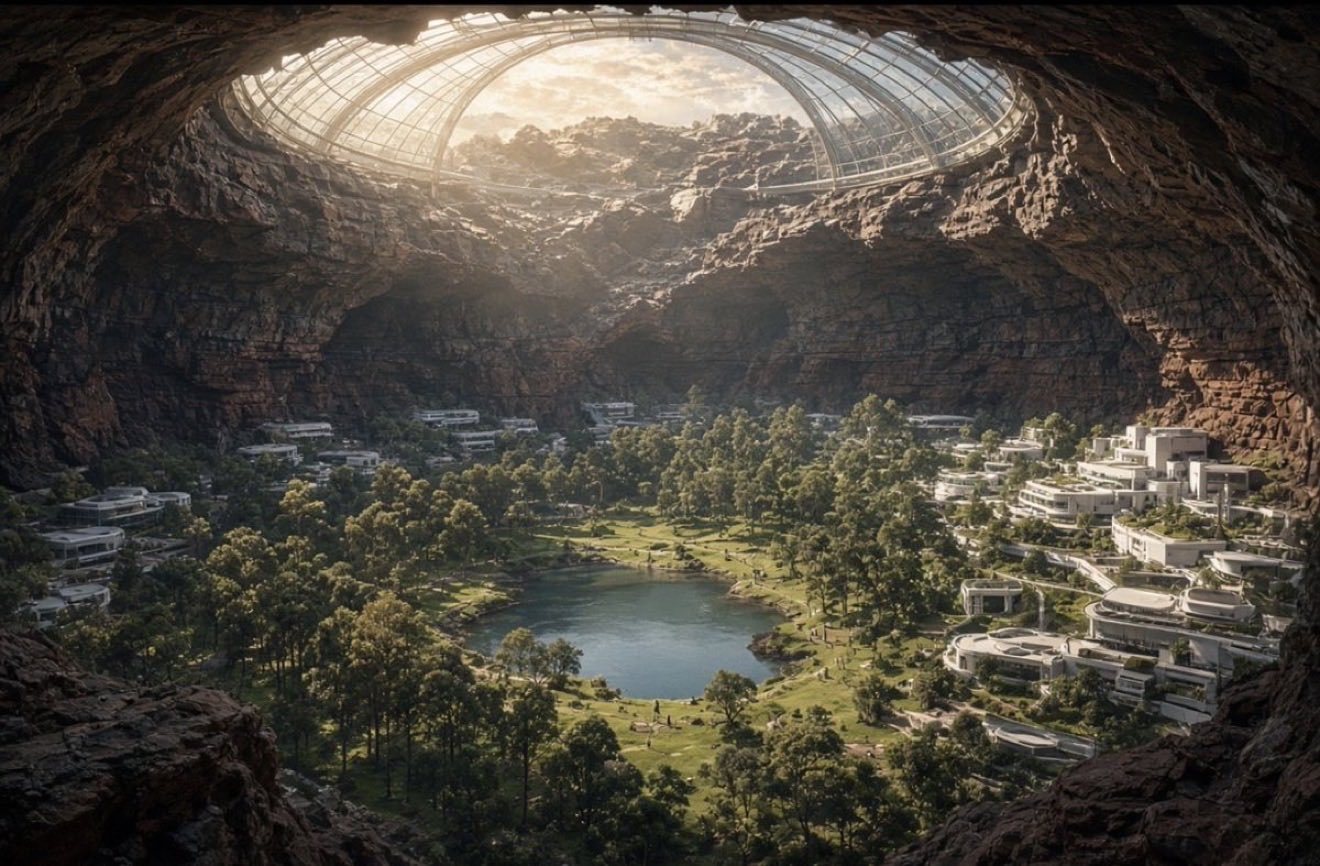
Mars, starting with water · independent concept work
I’m a builder who can’t stop thinking about how people could live on Mars. It’s independent concept work, I’m still learning, and none of it has been tested. I write it up the way I’d write up a job: what I know, what I’m guessing, and what I’d check before spending a dollar.

Bryan Adams, a builder in Tacoma, Washington. Corrections welcome on X.
Concept illustration, not a real photo and not a tested design. AI-generated artwork. Nothing like it has been built. Read how the idea starts. A real Mars photo is further down.
The centerpiece
I think out loud on X. Here are six of my Mars posts, picked for substance, and one page that joins them into a single read. My words, lightly trimmed, each linking to the original. Concept work, not tested; ice is probable, not proven.
01 Start with the end
“The first city on Mars should start as a water plant in a small crater.”
02 Is the water there?
“A candidate, not a selection. Ice in the ground isn’t proven recoverable water.”
03 Water first
“Water first: in [my thinking], water comes before propellant.”
04 Cut it or melt it?
“Two catches: bare ice on Mars turns to vapor fast, and much of it may be ice-soaked gravel, not clean ice.”
05 The engine
“Combustion is 2H₂ + O₂ → 2H₂O; argon is the recycled monatomic working fluid.”
06 Where it ends up
“Mars is a gas station first: water and fuel, with very little livable real estate.”
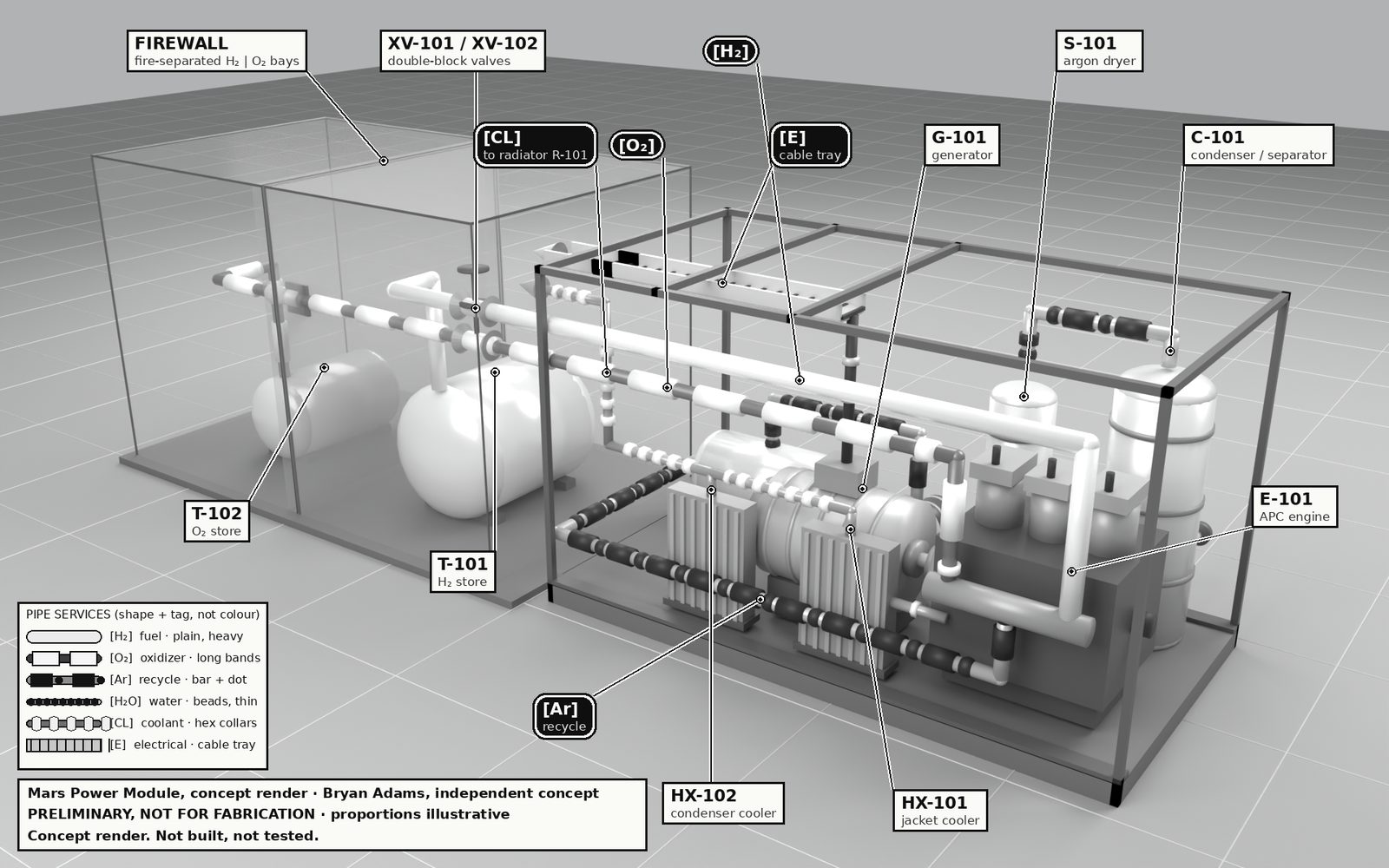
New: engine concept
A sealed hydrogen–argon engine that stores power on Mars and returns the water. It stores energy, it doesn’t make it: about 30% round trip Calculated from an assumed 10 kW module Estimate. A one-page overview, a four-sheet drawing set, and every number labeled.
My order of operations as a picture. Each link waits on the one before it. Concept only: not a layout, not tested.
Read this first: it’s concept work, I’m a builder and not a planetary scientist, and every claim carries a label (see below). Facts link to their sources.

For scale: what is really there
The illustration at the top of the page is concept art of an end goal. This photo is what an orbiter actually saw: ice dug up by a fresh impact. Ice in the ground is probable, not proven recoverable water. How I read the evidence.
Four posts so far, in the order I’d actually think about them. Short on time? Read 02, then 03.
Sort out the basics before anybody talks about finishes. For Mars, the basic is water.
Read post 01What orbiters have actually seen, what they haven’t, and why I won’t put a percentage on it.
Read post 02Let the ground do the pushing where it can. Then the arithmetic shows the pump was never the real energy bill.
Read post 03Six habits from job sites I’d carry over, and where I’d stop and hire an expert.
Read post 04Every claim on these pages carries one of these labels. They’re spelled out in words and drawn with different outline styles, so none of it depends on color.
A short list, because honest is better than impressive.
The conversation happens on X. If you know this stuff better than I do, I want to hear what I got wrong.